
Sunday, October 30, 2016

Friday, September 16, 2016
All pig farms to be relocated to Pasir Puteh Pig Farming Area
SIMUNJAN: Sarawak is pushing ahead to move all the 27 pig farms in Kuching, Kota Samarahan and Serian divisions to the Pasir Puteh Pig Farming Area (PFA) by December 2018 under the first phase of the project to integrate pig farming in one area.
Deputy Chief Minister Datuk Amar Douglas Uggah Embas said the state-of-the-art facility would house 250,000 standing pigs population (SPP) once the first phase of the project is fully implemented.
“We have been informed that as of today there are 27 lots available for farmers at PFA, which have been offered to the 27 respective farmers and 22 of them have indicated positively their intention to move their farms here.
“And we are confident that they will move in as most of them have paid their deposit ranging from RM30,000 to RM900,000 as required by the condition for them to operate here,” he said this during a press conference after his visit to the Pasir Puteh PFA, Simunjan here yesterday.
Uggah, who is also the Minister of Modernisation and Agriculture and Rural Economy said one of the target markets for PFA’s pork production would be Singapore, as PFA had been exporting its products to Singapore since last year.
He added up till August this year, PFA had exported a total of 668 tonnes of meat to the island republic and that it aimed to export one thousand tonnes by year-end.
“I was told there was a potential about five thousand pigs per day and at the moment, we are only supplying about one hundred per day, so there is a very big gap and it is a very big potential,” he said.
Meanwhile, during his visit Uggah pointed that various issues were raised and one of them was the land title and the legal status of PFA operators which will be brought up to the government by his ministry.
“I’m pleased to know we are exporting the product to Singapore that is a good beginning we hope in a year’s time by 2018 all the 27 or at least the 22 farmers who had responded positively will move into this place,” he said.
Uggah noted that the development of PFA is a long term strategy under the National Agriculture Policy to restructure the livestock breeding industry and transform, modernise and centralise the pig rearing industry.
We could also control the pig waste pollution through modern centralised waste treatment system and implement proper animal disease control and public health protection.
As of now, only 100ha of the 804ha have been utilised in the PFA with one anchor farm which started its production since 2010 with 4,974 SPP and this number increase to 22,401 in 2015, today there are 23,000 SPP.
He disclosed that the government had spent a total of RM212.98 million – RM143.2 million from the state government and RM69.78 million from the federal government to develop the phase 1 project, which commence in 2005.
Among those accompanying Uggah during the visit was Assistant Minister of Rural Economy (Interior Areas) and Plantation Datuk Francis Harden Hollis.
Friday, August 5, 2016
‘Pork export to S’pore can bring in RM325m annually
KUCHING: Sarawak can expect to get about RM325 million (SGD125 million) annually from exporting pork to Singapore from 2020 once the Pig Farming Area (PFA) at Pasir Puteh in Simunjan is fully utilised.
A State Veterinary Department spokesman said the first consignment last month to the island republic weighed 11,865 kg and was valued at RM151,476 (SGD58,260).
“Initially, we are talking about an annual revenue of some RM1.8 million, but we can expect a revenue of some RM325 million annually once the PFA reached its full potential in the next five years,” he told The Borneo Post yesterday.
He added that by year 2020, 90 per cent of pig farmers would be moving to PFA Pasir Puteh as required by the government.
“It would take some time for them to resettle there as it would involve a lot of investment to start new farms there.
This will include acquiring land and constructing the necessary infrastructure before they could move in. This is one of the reasons they have been very reluctant to be resettled there.”
However, the spokesman said one of the incentives for the pig farmers to move to PFA Pasir Puteh was that their farms would be awarded the Good Animal Husbandry Practices (SALT) certification, which could facilitate their products for export, especially to Singapore.
The spokesman said this when asked to comment on Natural Resources and Environmental Board (NREB) Controller Peter Sawal’s statement yesterday that all pig farms from Kuching and Samarahan divisions were expected to move to state-of-the-art PFA Pasir Puteh by 2020.
Currently, only one anchor farm is operating there since 2007, and an additional four main pig farms would be moving there soon as the farmers were now constructing the pen houses and other infrastructure.
The 804 ha PFA Pasir Puteh was implemented in accordance with European Union (EU) standard. Some RM200 million had been spent on facilities and infrastructure, and an additional RM200 million to complete the whole project.
When completed, the PFA would be the biggest of its kind in the country and the most advanced in the region. Waste products such as biomass from the farm would be recycled and used for generators, making the farm sustainable.
When fully operational, the farm would be able to process 500,000 porkers a year, with a total turnover of RM500 million.
The PFA has a capacity of 250,000 of standing pig population (SPP) and the abattoir facilities would be able to process up to 1,500 heads of pigs a day.
The abattoir facilities, based on a German technology, consisted of a modern slaughter house cum processing plant.
PFA Pasir Puteh was implemented under the National Agriculture Policy (NAP) 1984, which requires pig production to be carried out in designated areas.

Friday, July 22, 2016
Sarawak State makes breakthrough in pig farming
Sarawak has a made a breakthrough in pig farming and has made the stringent Biosecurity and Sanitary and Phytosanitary requirements by Agriculture and Veterinary Authority, Singapore for the export of pork.
“We are now exporting frozen pork to Singapore. The first container was shipped out to Singapore on 2nd February 2015 with a total nett weight of about 12 mt,” Deputy Chief Minister and Minister for Modernisation of Agriculture Datuk Patinggi Tan Sri Alfred Jabu Numpang said in his winding-up speech in the State Legislative Assembly here yesterday.
Since then, he added, a total of twenty five containers with total nett weights of 413 metric tones had been exported to Singapore.
“The export is on going with around 60 metric tones targeted per month,” he said.
With regards to the progress of the centralised pig farming Area at Pasir Putih, the Archor Farm currently has a total of 22,500 standing pig population (SPP).
Another twenty two pig farmers from Kuching and Samarahan Divisions were expected to move into the pig production area latest by 2018.
The projected pig production from the Pig Farm Area shall reach 250,000 SPP from 2020 onwards. When phase 2 of the project is completed, a turnover of 500,000 porkers with a total estimated value of RM500 million per year is expected.
On the progress of the implementation of Agropolitan projects in Sarawak, he informed the august House that out of the five areas being developed, namely Batang Sadong, Samarahan, Pulau Bruit Mukah, Batang Lupar Sri Aman, Gunung Sadok Betong and Kedaya Telang Usan in Ulu Baram, the first three areas that have been planted with oil palm have now started to bear fruits.
For Gunung Sadok, he said, the rubber trees which were planted in the first phase would be ready for tapping by 2017/2018.
“Through this project, the Government hopes that the participants will be able to improve their income level and subsequently be out of poverty,” he said.
Jabu said, his Ministry was working closely with the Federal Ministry of Plantation Industry and Community (MPIC relating to the future development for Sarawak to embark on latex industry.

Friday, October 16, 2015
Ng’s farm breaks Singapore’s ban on Malaysian Pork
KUCHING: Singapore has lifted a 16-year-ban on import of pork from Malaysia and is importing 100 tonnes of the meat from the state.
The pork exported to the island republic is from the piggery of Dr Ng Siew Thian, located at the state-of-the-art Pig Farming Area (PFA) at Pasir Puteh near Simunjan.
Presently, only pork from Ng’s farm has been approved by Singapore’s food authorities.
His pork products sold are now available at selected NTUC FairPrice Supermarkets.
Ng, who exports his produce under the trademark ‘Borneo Pork’, told The Borneo Post yesterday that pig farming had a huge potential to grow if breeders could meet the quality demand of importing countries.
He called on pig farmers in the state to relocate their farms to PFA so that they could utilise the modern facilities there to produce high quality meat.
Ng, who is a veterinarian, said pork export to Singapore had been on the increase — he could export as much as 200 tonnes per month.
“For those who are interested to export to Singapore, come to PFA. We can do it together. Singapore is asking for more to be exported.”
He said although prices of pork in export and local markets were more or less the same, the international export market had an almost unlimited capacity.
“Sarawak is suitable for farming activities. Export can raise the standard of local production as there is expectation in export quality. At the end, the local consumers will also benefit,” said Ng, who is also secretary of Sarawak Livestock Breeders’ Association (SLBA).
The RM200-million Pasir Puteh PFA was built in accordance with European Union (EU)’s standard and another RM200 million will be needed to complete the whole project.
When completed, PFA would be the largest of its kind in the country and the most advanced in the region. Waste product such as biomass from the farm would be recycled to generate energy to run the farm, making it self-sustaining.
It has a capacity to accommodate 250,000 pigs and the slaughterhouse built based on German technology would be able to process up to 1,500 pigs per day.
When fully operational, the farm will be able to process 500,000 pigs a year with a total turnover of RM500 million.
Built under the National Agriculture Policy 1984 which requires pig production to be carried out in designated areas, Pasir Puteh PFA caters for the more than 70 pig farmers here and in Kota Samarahan.
Read more: http://www.theborneopost.com/2015/10/17/ngs-farm-breaks-singapores-ban-on-malaysian-pork/#ixzz3onxQLY6s
Frozen pork from Sarawak is now available at NTUC FairPrice Supermarket
SINGAPORE - Frozen pork from Sarawak is now available at NTUC FairPrice supermarket stores here, following the Government's approval of the Malaysian state on the island of Borneo.
Mr Tng Ah Yiam, Deputy CEO (Merchandising) at FairPrice said: "We have worked closely with our suppliers and AVA to bring in frozen pork from Sarawak that meets stringent food safety requirements. As the largest supermarket retailer in Singapore, the expansion of our range of pork products allows us to diversify our offerings and maintain stability in prices and supplies for our customers."
The frozen pork, which is pre-thawed for shoppers' convenience, is sold exclusively by FairPrice under the "Borneo Pork" brand and hit the shelves about a week ago.
The pork is available in eight types of cuts, including lean, minced, fillet and ribs. It is sold at selected major FairPrice stores, as well as FairPrice Finest and FairPrice Xtra.
Ms Tan Poh Hong, CEO of Agri-Food and Veterinary Authority (AVA), welcomes the news that FairPrice is carrying Sarawak pork in its stores.
"With the successful accreditation of Sarawak, Singapore's frozen pork supply is further diversified. Sarawak's proximity to Singapore may make it a significant source of frozen pork. AVA will continue to diversify our food sources so that Singapore is better buffered against potential supply disruptions," Ms Tan said.
FairPrice's current pork supply includes frozen pork from Brazil, the United States, Holland and Spain, as well as chilled pork from Australia and Indonesia.
Wednesday, March 25, 2015
PFA Pasir Puteh, Simunjan will fully operational by 2020
KUCHING: All pig farms in Kuching and Samarahan divisions are expected to move to the state-of-the-art Pasir Puteh Pig Farming Area (PFA) near Simunjan by 2020, said Natural Resources and Environment Board (NREB) controller Peter Sawal.
He said the present anchor farm that had been operating there since 2007 would be joined by four main pig farms that would be moving there soon, as the farmers were constructing the pens and other infrastructure.
“By 2020, all pig farmers from both Kuching-Samarahan divisions are expected to operate from there,” Peter told The Borneo Post here yesterday.
The 804ha Pasir Puteh PFA is implemented in accordance with European Union (EU) standard.
Peter added that that once all the pig farmers had moved to the PFA, rivers and streams which were now affected by the discharge from their present farms could slowly be rehabilitated.
Some RM200 million has been spent on the facilities and infrastructure at PFA but another RM86million is needed to complete the whole project.
When completed, the PFA would be the biggest of its kind in the country and the most advanced in the region. Waste products such as biomass from the farm would be recycled and used for generators for the farm, thus making the farm sustainable.
When fully operational, the farm will be able to produce 500,000 porkers a year, providing a total turnover of RM500 million in contribution to the state.
The PFA has a capacity of 250,000 standing pig population (SPP) and the abattoir facilities will be able to process up to 1,500 heads of pigs a day.
The abattoir facilities, based on a German technology, consist of a modern slaughter house cum processing plant.
Pasir Puteh PFA is implemented under the National Agriculture Policy (NAP 3) which requires pig production to be carried out in designated areas.
Meanwhile, when contacted, Assistant Minister of Public Health Datuk Dr Jerip Susil agreed that all the pig farms in Kuching and Samarahan divisions be relocated to the Pasir Puteh PFA to prevent the occurance of diseases such as Japanese Encephalitis (JE).
Read more: http://www.theborneopost.com/2015/03/25/pasir-puteh-pfa-to-house-all-pig-farms-in-kuching-samarahan-by-2020-nreb/#ixzz3VOlkFKN5


Modern closed house system to ensure high productivity and Good Animal Husbandry Practice (GAHP)
Saturday, October 4, 2014


Sunday, August 10, 2014
Indigenous Pig in Lundu, Sarawak
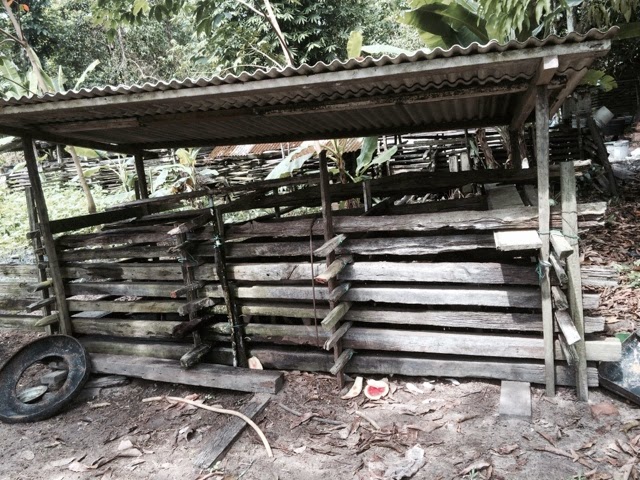
Local pig project at Kpg Sebat Dayak, Lundu. Current population is more than 100 heads in an area of 6 acres . More than 65 heads sold every year at RM12 per kg. The average weight is 40 kg per head.




Saturday, August 9, 2014
Farmers Union in PFA
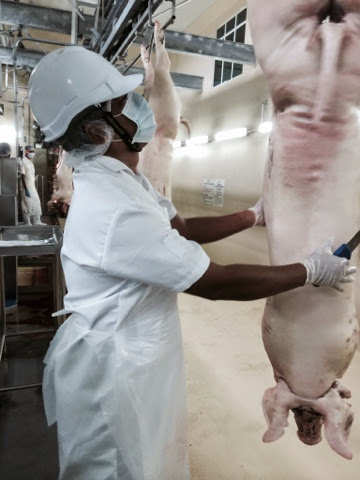
Construction of multification unit by Farmers Union started in 20 February 2014.




Wednesday, July 2, 2014
Pig blood samples taken
KEPALA BATAS: Blood samples of pigs were taken in Kampung Selamat to determine whether the latest Japanese Encephalitis case was caused by those animals in the village.
State Veterinary Department director Dr Johari Abu Bakar said 40 officers were sent to 19 pig farms located within a 1.5km radius of SK Kampung Selamat to collect blood samples.
“A total of 190 samples were taken and sent to the department’s laboratory in Bukit Tengah and Ipoh. The results are expected to be known on Friday.
“For the time being, our department will closely monitor the Kampung Selamat pig farms, which have more than 10,000 such animals,” he said when contacted yesterday.
Year Six pupil Muhammad Ammar Muqrish Zulkifli from SK Kampung Selamat in Tasek Gelugor, Butterworth, was believed to have contracted JE while on a camp programme organised by the school at its premises in April.
Pig farmer Teoh Chiew Seong, 72, said there should be no finger-pointing before the blood test results are out so that any public anxiety can be avoided.
“No one can confirm whether the disease originated from the pigs here (Kampung Selamat). Pigs are not the only animals which carry the JE virus. It can also be from birds or even cows or goats (through its vector, the Culex mosquito).
“However, pig farmers here are willing to cooperate with the authorities by allowing them to collect blood samples from the pigs for test,” he said, adding that there were about 700 families staying in Kampung Selamat, of which 80 were involved in pig farming activities.
Doctors said Muhammad Ammar was out of danger but the disease had damaged his brain.
Consultant neurologist Dr Wong Yee Choo said that the boy suffered permanent oral disability, was unable to talk or walk and in a semi-conscious state.
“His fever is under control but the infection has damaged his brain and he suffers from occasional seizures.
“He will have to undergo rehabilitation. Even then, he may never fully recover,” he said when met at Pantai Hospital in Bayan Baru.
Muhammad Ammar’s mother Haniza Ayob, 40, who is a factory worker, said she had accepted that her son would need constant care.
“My eldest child can open his eyes and move his hands but he is unable to say anything to us.
“My husband works as a factory supervisor. We are at our wit’s end as we have already spent RM87,000 for his treatment.
“I do not know how we are going to come up with more money,” she said at the hospital.
They have four other children.
State Health Committee chairman Dr Afif Bahardin said the state government would see what it could do to provide financial help to the family.
On the pig farms being the possible cause of JE, he said he would work with the local council and state health department to conduct tests before deciding on the next course of action.The Star
Wednesday, June 11, 2014
S’pore keen to import pork from Simunjan
KUCHING: Singapore is keen to import pork from the centralised pig farming area in Pasir Puteh, Simunjan.
Natural Resources and Environment Board (NREB) controller Peter Sawal said an official delegation from Singapore inspected the centralised farm in February, conducting assessment and auditing for certification purposes.
“Singapore is keen to make the centralised farming area in Simunjan as its main producer and supplier of pork.
“The interest from Singapore is a great encouragement for the local farmers to breed pigs and produce pork there, not just for local consumption but also for the international market,” he told The Borneo Post.
Peter said Singapore is keen to import pork from the region as it is free Foot amd Mouth Disease (FMD)
He said piglets for rearing would also be produced at the centralised farm, adding that the brood stock was imported from Europe. Peter said the 2,000-acre farm, which is about 120km from here, costs RM163 million and is currently the biggest such facility in Sarawak.
It is equipped with a biogas waste treatment plant, which if fully operational would be able to produce between three and five megawatts of methane-powered electricity. The whole farming area could accommodate a standing pig population of 250,000.
“Pigs are high waste producers. One pig produces about five times more excrement than a human being does. So the biogas may be sufficient for internal use,” he said. The establishment of the centralised pig farming area is for the purpose of relocating existing pig farms in Kuching and Samarahan divisions for better control of environmental pollution associated with the industry.
It is a fully integrated complex covering the entire value-chain and is designed for zero waste discharge aside from eliminating unpleasant smells.
The facilities and management systems are designed to comply with national and international standards with modern pig farms, feed mills, abattoir and meat processing plants.

Read more: http://www.theborneopost.com/2014/04/16/local-news-coming-soon-booking-minits-16-april-12/#ixzz34K1Av7xE
Tuesday, May 28, 2013
Pig Farming Area (PFA) in Sarawak
Phase I of the PFA development is almost complete, the last remaining works being the Biogas Plant which is now 94% complete and is scheduled for commissioning in July 2013. Once the bio-gas plant is commission, the farmers could move in.

At present, 28 lots are ready for occupation by approved pig farmers. To date, five farmers have moved into the PFA and started construction works on their farm buildings and facilities.
The establishment of the Pig Farming Area (PFA) at Pasir Putih, Samarahan Division is for the purpose of relocating existing pig farms in Kuching and Samarahan Divisions to a centralised location for better control of environmental pollution associated with the industry.
The PFA is a fully integrated complex covering the entire value-chain and is designed for zero-waste discharge besides eliminating unpleasant smells. The facilities and management systems are designed to comply with exacting national and international standards, from the modern pig farms, feed mills, abattoir and meat processing plants. The whole PFA can accommodate a standing pig population of 250,000 heads.
Thursday, February 14, 2013
Pig DNA in Golden Churn Creamery Butter
KUCHING: Muslims in the state were advised to stop consuming the ‘Golden Churn Creamery Butter’ with immediate effect as the product was tested and confirmed to contained DNA from pigs.
Sarawak Islamic Council secretary Abang Shamsudin Abang Seruji, in a press statement earlier today, said a sample of the product was sent to the Malaysia Chemical Department and the result on July 19 had confirmed the existence of pig DNA in the product.
Shamsuddin warned Muslim consumers not to purchase the product which was available widely in the state.
For more information and inquiries regarding the issue and halal certification on products in the state, the public can log on to Sarawak Islamic Department’s website www.jais.sarawak.gov.my.
Read more: http://www.theborneopost.com/2011/07/28/pig-dna-in-golden-churn-creamery-butter/#ixzz2KssYzmiK
Tuesday, November 20, 2012
Precious Food Production on quest to change the local mentality on fresh meat
KUCHING: Precious Food Products Sdn Bhd (Precious Food Product) is on a quest to change local mentality that fresh pork products can also be found in the supermarkets now and not just at the daily wet market.
Abattoir manager, Dr Francis Sia a former vet from the state veterinary department stated that in terms of standards, the company’s stringent guidelines ensured that the pork products produced at the facility were safer than anything that could be found in the wet market.
“We are following international guidelines as the products made here are for the export market. All equipment are sterilised after each animal so there’s no cross contamination.
“The practice of blast chilling the meat after cleaning and gutting and keeping them in a chiller also helps prevent the spread of potential diseases as bacteria and viruses will not survive extreme cold,” stated Sia.
The total investments made towards the abattoir was RM30 million with RM20 million for the abattoir and an estimated RM10 million for the chiller systems stated sales manager Lester Chung.
The abattoir was fully automated with the equipment completely online so troubleshooting could be done from the equipment manufacturer’s home country in Germany and at full capacity, the abattoir could process 120 units per hour on two eight hour shifts.
However, as the company was still new, it only processes once a week at roughly 100 per session.
“Despite the capability to process such high numbers, we still keep a very stringent quality control with two government meat inspectors checking every single animal for any diseases or contamination.
“We also monitor the supplier to ensure that it follows government guidelines and require appropriate certification for every supplier we contract,” stated Sia.
Sia further added that due to Sarawak’s high requirements for waste management for livestock, all solid waste from the abattoir was sent for incineration while liquid waste was channelled to a nearby biogas facility to produce electricity.
“The reason for the high standards is because the bulk of the processed products here is meant for export to countries like Singapore. There are certain standards that need to be followed for the product to be export standard and we are also applying such standards to what we cater locally.
“We do bacterial swabs on random meat samples, the equipment as well as the vicinity to doubly ensure the safety of our products as well,” Sia explained.
Despite chilled meats being able to last up to five days in the chiller, the company recalled any product that has been on the shelf for three days to ensure the freshness of the meat, Chung said.
“It is still an ongoing process to change the people’s mentality but we are taking every measure to keep our products fresh and with that I believe that sooner rather than later people will understand that fresh meat can be found elsewhere other than the markets and that you do not have to wake up really early in the morning to get it,” stated Chung.
Read more: http://www.theborneopost.com/2012/11/21/precious-food-production-on-quest-to-change-the-local-mentality-on-fresh-meat/#ixzz2CoAobf16
Monday, April 30, 2012
Posted on April 26, 2012, Thursday

Global
fast food chain Burger King will soon be serving up morsels from free
range eggs and pigs, the company said in a statement Wednesday. (AFP
Photo/Robyn Beck) Global
fast food chain Burger King will soon be serving up morsels from free
range eggs and pigs, the company said in a statement Wednesday.
The
company — which has 12,500 locations worldwide — pledged to use 100
percent cage-free eggs in the US within five years and to only buy pork
from suppliers who stop using gestation crates to breed pigs.
The pledge was made in a joint statement with the Humane Society.
“For
more than a decade, Burger King Corp. has demonstrated a commitment to
animal welfare,” said Jonathan Fitzpatrick, chief brand and operations
officer. “We continue to
leverage our purchasing power to ensure the appropriate and proper
treatment of animals by our vendors and suppliers.”
The Humane Society, which lobbies for animal rights, welcomed the move.“These
changes by Burger King Corp. will improve life for countless farm
animals and encourage other companies to abide by animal welfare
principles up and down their supply chain,” said Wayne Pacelle, head of
the group. –AFP
Saturday, January 7, 2012
Pig farming land in Sibu approved
by Jane Moh, reporters@theborneopost.com. Posted on January 7, 2012, Saturday

FOR THE ALBUM: (from sixth right) Dr Chin, Wong, and Abdul Azziss at the dialogue session.
SIBU: The state government has approved a piece of land spanning 1,332 acres for centralised pig farming by the Sibu Livestock Farming Association (SLFA).
During a dialogue session with the association at the Land and Survey Department (LSD) here yesterday, Second Minister of Finance Dato Sri Wong Soon Koh announced that it was a yet-to-be-surveyed state land lying within the Licensed Planted Forest (LPF). “It is located at the boundary of Sibu-Bintulu divisions, about 1.2km from the main road and approximately 70km from Selangau Bazaar. “The nearest longhouse is about 2.6km away. So, there is no need to worry about the land being subjected to claims by natives on the ground.”
Wong said the earmarked area was suitable for pig farming as it was flat and on high ground.
“The site is about 1.2km from the main road, so it is easily accessible. Electricity and water can be connected from the main supply along the Sibu-Bintulu road.”
He told reporters that the association had been looking for a proper farming area for the last 10 years because pig farming is currently being carried out all over Sibu. Most of these farms could not comply with Natural Resource Environment Board (NREB) regulations, and thus were often slapped with compounds for environmental pollution.
“It is not their (pig farmers) fault because they started the farms about half a century ago. “Unless a new farm is set up, it is very difficult to meet all the legal requirements.” Association chairman Ling Chi Kiong, who was also present, said he would discuss with his committee on how to develop the land into a farming area. Also present were the project director (Pig Farming Area) of the Agriculture Department Dr Chin Vei Ching and LSD acting superintendant Abdul Azziss Abdul Kadir.
Pig farmers undecided about centralised centre
by Karen Bong and Wilfred Pilo, reporters@theborneopost.com. Posted on September 6, 2011, Tuesday

BIG FARM: The pig farming area in Pasir Puteh.
KUCHING: The centralised pig farming area located in Pasir Puteh, Simunjan, about 120km from here, will be in operation once the bio-gas waste treatment plant is completed, possibly by next year. All pig farmers in Kuching and Samarahan are expected to move to the 2,000-acre farm equipped with modern facilities, costing about RM163 million, making it the biggest pig farm in Sarawak.
Minister of Environment and Public Health, Dato Sri Wong Soon Koh, when contacted recently, told The Borneo Post that the RM93 million bio-gas waste treatment plant was 70 per cent complete. “Now we are waiting for the plant to be completed. After that, we will make sure that the facilities are running before all the farmers can move there.
“We have also held several dialogues with the pig farmers from both Kuching and Samarahan divisions regarding the move but more discussions will need to be held,” he said. Wong, who is also Second Finance Minister, disclosed that 12 farmers have volunteered to move to the new site. “The ministry has issued letters to 72 licensed pig farmers in these two divisions, informing them that they can move to the site,” he said.Wong encouraged all the pig farmers to move together as it would save them cost and time.“And at the same time they could assist each other especially when problems arise,” he said.
Meanwhile, the chairman of Kuching and Samarahan Pig’s Farmers Association Dr Ng Siew Tsing confirmed that the government had issued letters to the pig farmers. A piece of land will be given to individual pig farmers to set up their business and they have been briefed on the breeding conditions, he revealed. “The only thing they have not been told is the amount they need to pay in land premium once they occupy the land,” he said.
However, it was understood that not all pig farmers have agreed to move as there were many aspects to the shift that had to be considered and solved beforehand, especially the cost of moving.
When The Borneo Post reporters approached a pig farmer who only wanted to be identified as Chai, a member of the Kuching and Samarahan Pig’s Farmer Association, they were informed that he was unlikely to move due to the high cost. “The estimated moving cost is about RM3 million, which we have to bear on our own. Also, our land will then be abandoned,” he said.
The cost of moving, Chai pointed out, covered the setting up of their own facilities which included construction and material, as well as the construction of in-roads to the given land and transportation.
“We are slowly shrinking our pig farming business now. The cost of moving is too high and we are unable to afford it,” he added. While having to bear the high cost of moving, Chai also noted that the investment returns would be slow and thus “not ideal”. “The first generation pigs cannot be sold and piglets have to be purchased from the ministry but farmers could probably acquire it cheaper outside. The price is being controlled by the authorities,” he explained.
On the size of land given to individual pig farmers, Chai said the land would be apportioned based on productivity which he thought unfair and suggested that a better evaluating system was needed. “For instance, if we have 30 sows (female pigs), a land for that size will be given. So it will be hard if we want to expand,” he continued.
While it is good to have a centralised pig farming area, Chai thinks it would have negative impact on the business, especially sellers having to travel to the outskirts of town to source for it. “Meantime, we will have to wait for meetings to be called where these issues will be highlighted to find the solutions,” he said.

GUARDED: The security guard house at the pig farming area in Pasir Puteh.

IMPRESSIVE: The abattoir (slaughter-house) at the Pig Farming Area in Pasir Puteh.
Modern pig waste treatment system ready in March 2012
Posted on June 30, 2011, Thursday
A MODERN waste treatment system capable of treating waste produced by 35,000 standing pig population in the state will be ready by March next year.“This centralised system is designed to produce zero discharge while the biogas generated can be used to produce electricity,” said Minister of Modernisation of Agriculture Datuk Patinggi Tan Sri Alfred Jabu in his winding-up speech here yesterday. He was referring to the implementation of integrated pig farming area project in the state. “To address the environmental pollution and to modernise the pig industry, the government has initiated a modern and integrated pig farming area at Pasir Puteh in Simunjan. “A world class standard abattoir compliant with Hazard Analysis Critical Control Point is ready for use,” he said.
According to Jabu, one of the key components of the project was the establishment of an anchor farm to supply high quality breed stocks for the relocated pig farmers, which had been in operation since 2009, and was now producing 6,000 breeders.
He added that pork produced in the pig farming area would cater for both local and export markets.
“Our contact in Singapore has indicated that the country is keen to import our pork and the AgriFood and Veterinary Authority of Singapore will audit the pig farming area when the slaughtering of pigs commences.
“As a pork producer, we have the competitive edge because of our freedom from major diseases,” he said.


Subscribe to:
Posts (Atom)